

Photographing an Eclipse
- OwenGwynne
- Jun 27
- 2 min read
At the end of this, there is a general piece of advice that is very commonly given to people going to their first total eclipse
On the evening of 12th August, there will be a Solar Eclipse that tracks from Iceland, down the North Atlantic and across the Spanish mainland and the Balearic Islands

Solar Eclipses have two phases - but most people will only see one of them.
The Partial phase is when only part of the Sun's disc is covered by the Moon.
The Total phase is when the Moon fully covers the Sun's disc and the sky goes dark.
Visibility of the Partial phase covers a much wider area on the Earth's surface, and lasts a lot longer in time as well, so most of your photographic opportunities will be for Partial eclipses - and if you're not fortunate enough to be on the path of Totality, this is the ONLY type of photography you'll be able to achieve.
Point 1: For the Partial phase of the eclipse, you must use a suitable filter, and ensure it is firmly attached to your camera
Point 2: Even if you are on the path of Totality, you will only have a short time to be able to take the photographs.
A comprehensive summary of the options available can be found at Alex Conu's article
There are software tools to help you with imaging eclipses - though many will only work with specific camera brands
Eclipse Orchestrator (free version) – laptop + Canon/Nikon
SETnC – laptop + Canon
Eclipse Droid - Android phone + Canon/Nikon
Eclipse Maestro – Mac + large range of cameras
Despite what is said elsewhere this software does not run on iPhone/iPad
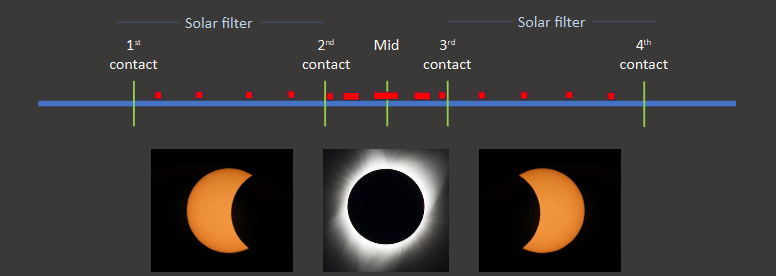
With the eclipse details loaded alongside your plan - on the day you enter your location and time as accurately as you can, and the software makes the camera follow your plan.
The piece of advice that I mentioned
If this is your first total eclipse - be aware that it's more important that you experience the eclipse than that you get the best images of it. Very likely you will not be getting the best ever images - so concentrate on enjoying it. Maybe use a video camera (with a filter) to capture the progression of the partial phase, and then scan around during totality to capture the responses of the people around you.
The press next day will be full of really excellent images that will remind you of the day itself.
Thanks to Paul K for the links
I hadn't realised it would be 90% from Cheshire, so definitely worth trying to see. I simulated it using Stellarium and the timings are as follows:
1st contact: ~1814 hrs, altitude of Sun ~21 degrees, direction: a few degrees S of W.
Maximum: ~ 1909 hrs, altitude of Sun ~13 degrees, direction: a few degrees N of W.
Last contact: ~2000 hrs, altitude of Sun ~6 degrees, direction: a few more degrees N of W.
It might be best to try observing from a hill with a clear view W.
Graham Beamson, 10th July 2026.